

Study Day: The Arab Hall, Past and Present - In collaboration with Community Jameel
About the Study Day
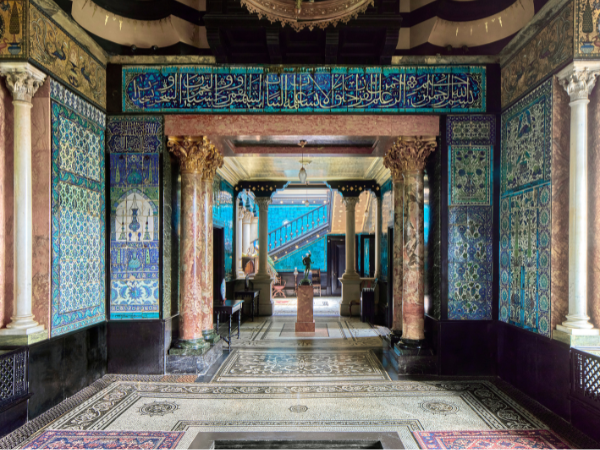
An engaging and informative full-day study session exploring several aspects of Leighton House’s major exhibition, The Arab Hall: Past and Present. From an exploration of some of the more unusual tiles decorating this iconic room, to new readings of their calligraphy inscriptions, to the making of the newly commissioned film ‘When The Tiles Spoke’ and the ideas and process behind two of the site-specific contemporary installations on display.
Community Jameel will also join the Study Day and present their work in the traditional arts through the Jameel Houses of Traditional Arts in Cairo, Jeddah and Scotland.
Useful information
- The ticket price includes all the sessions, access to the historic house and exhibitions.
- Refreshments and lunch will be provided (refreshments on arrival at 9:30am and during afternoon break).
- All levels of interest welcome.
Programme
Traditional Arts with Community Jameel - George Richards
Exploring the work of The Jameel Houses of Traditional Arts in Cairo, Jeddah and Scotland to preserve, teach, and promote traditional arts and crafts. Established by Community Jameel and The King’s Foundation, these specialized educational centres foster local craftsmanship and empower young artisans to become entrepreneurs. These hubs provide training in many of the traditional arts and crafts found in Leighton's Arab Hall, including ceramics, gypsum, woodworking and metalwork.
Reconstructing Frederic Leighton’s Collection of Islamic Art - Dr Melanie Gibson
Before becoming President of the Royal Academy in 1878, Frederic Leighton travelled to southern Spain, Egypt, Turkey and Syria. During these trips he developed an interest in Islamic architecture and design and started to build a collection of tiles, ceramics and textiles, buying in the cities he visited, as well as more locally in Paris and London. His collection was entirely dispersed after his death, but several of the pieces that once belonged to him can be identified.
Dealing with Damascus Rooms in London - Dr Moya Carey
From the 1870s to 1890s, Caspar Purdon Clarke (1846-1911) had a direct role in sourcing architectural salvage from Syria, Turkey and Iran for commercial, institutional and private buyers in London, most notably for Frederic Leighton’s extraordinary house in Holland Park. Clarke’s supply role overlapped with his employment at the South Kensington Museum (today the V&A), where ‘Period Rooms’ were increasingly preferred for gallery displays of historic interiors. Businesses in Syria and Lebanon dealt in modern reproductions of ‘Damascus Rooms’ as well as historic salvage, and exported to clients abroad: in 1894 the firm of Habra Brothers offered one spectacular panelled room to the London museum, but Clarke negotiated a different outcome.
The Inscriptions in the Arab Hall — Hidaya Abbas
The inscriptions in the Arab Hall serve not only as decoration but also transform the space into an imaginative sacred sanctuary that encourages intercultural exchange and cross-cultural dialogue. The Qurʾanic verses and prayers inscribed within it address themes such as mercy, protection, and blessing. This analysis explores their translation and interpretation, highlighting the significant challenges and insights that arise from this complex textual tapestry.
When The Tiles Spoke — Soudade Kaadan
Award-winning Syrian filmmaker, Soudade Kaadan - Nezouh (2022), The Day I Lost My Shadow (2018) - presents her new short film, commissioned by Leighton House. When the Tiles Spoke is a hybrid fiction film that blends magical realism and dreamscape, taking viewers on an immersive, emotional journey. Through film, narration and animation, the magnificent tiles in the Arab Hall come alive, finding their own voice to recount their origins and their journey to Leighton House.
James Wild in Cairo: His Drawings of Four Reception Rooms - Dr Omniya Abdel Barr
Historically known as salamlik, majlis, mandara, qa’a, and until recently udit al-musafirin, or room of travellers, Cairene homes, both large and or small, had a special room for receiving and entertaining guests. The sketchbooks of the British architect James W. Wild, now held in the V&A, give us a glimpse of reception rooms in houses that have since been demolished. They capture the rich details and elaborate decoration and are an incredible record of the city’s 18th- and 19th-century domestic architecture.
Stencilled Tiles from Ottoman Jerusalem and Damascus - Charlotte Maury
Two religious tile inscriptions, a basmala and a portion of Surah al-Rahman from the Qurʾan, were integrated by the architect George Aitchison (1825‒1910) into the magnificent decoration of the Arab Hall. Although their original provenance has been lost, they can both be related to similar tile panels in Jerusalem and Damascus and their close resemblance can be explained by the use of stencils that enabled the production of identical designs at different periods. The originals were created in 16th-century Ottoman Syria and Palestine when there was an increase in tile production, fuelled by the restoration and building campaigns sponsored both by the Ottoman sultan and by provincial governors.
Artists Responding to the Arab Hall — Hannah Lund in conversation with Ramzi Mallat, Kamilah Ahmed and Soraya Syed
Leighton House Curator of Exhibitions & Displays, Hannah Lund, in conversation with the three contemporary artists who have responded to the Arab Hall with site-specific commissions as part of the multidisciplinary project, The Arab Hall: Past and Present. Each engaging with the Hall's architecture, materials and layered histories, the artist's offer fresh perspectives through their individual works; Atlas of An Entangled Gaze by Ramzi Mallat (21 March - 13 May); Facets in Resonance by Kamilah Ahmed (15 May - 30 July); and From Water, Every Living Thing by Soraya Syed (31 July - 4 October).
Meet the speakers
George Richards (Director, Community Jameel)
George Richards is the director of Community Jameel, which supports the advancement of traditional arts, including programmes with the King's Foundation and the V&A as well as cultural programmes such as the Iraq Cultural Health Fund. An established leader in cultural heritage protection, George previously led field expeditions to document endangered cultural heritage on behalf of the British Library and the British institute for the Study of Iraq.
Melanie Gibson (Islamic art expert, exhibition co-curator & author)
Dr Melanie Gibson is a lecturer and writer on the history of the ceramics of the Middle East. Having studied Arabic at Oxford University, where her interest in the history of the ceramics of the Islamic world began, she gained her doctorate at SOAS, University of London. She is co-curator of The Arab Hall: Past and Present and author of the newly published The Arab Hall: Frederic Leighton, Traveller and Collector.
Moya Carey (Chester Beatty, Dublin)
Dr Moya Carey is Curator of the Islamic Collections at the Chester Beatty, Dublin. She worked previously (2009‒18) as the Iran Heritage Foundation Curator for the Iranian Collections at the Victoria and Albert Museum in London. She is interested in visual culture in all media and the cultural contexts surrounding later appropriations, re-use, collecting history and provenance.
Hidaya Abbas (PhD student, SOAS)
Hidaya M. Abbas is currently a PhD candidate in the History of Art and Archaeology at SOAS, University of London, where she focuses on the architecture of the late Ottoman Arab World. Hidaya’s work combines academic teaching, research, and curatorial practice with publications on Islamic architecture and urban heritage.
Soudade Kaadan (Filmmaker)
Soudade Kaadan is a Sundance and Venice award-winning Syrian filmmaker. She gained international recognition with her debut feature, The Day I Lost My Shadow (2018), followed by Aziza (2019) and Nezouh (2022). When The Tiles Spoke (2026) was commissioned by Leighton House as part of The Arab Hall: Past and Present, which gives voice to the tiles as witnesses to a journey across centuries and borders.
Omniya Abdel Barr (V&A, London)
Dr Omniya Abdel Barr is an architect and historian of Islamic art and architecture with a focus on Mamluk Cairo. She holds a PhD on Islamic history from Provence University, Aix-Marseille (2015). She joined the Victoria and Albert Museum (V&A) as a researcher in 2016, working on the collections from Egypt with a focus on photography, paintings, and architectural drawings.
Charlotte Maury (Louvre, Paris)
Charlotte Maury is a Collection Manager in the Department of Islamic Art at the Musée du Louvre, Paris. Since 2007 she has been in charge of the collections of Turkish and Ottoman art and the arts of the book across the Islamic world. She has collaborated on several exhibitions organized by the department.
Hannah Lund (Curator of Exhibitions and Displays, Leighton House and Sambourne House)
Hannah Lund, Curator of Exhibitions and Displays at Leighton House and Sambourne House, is currently focused on the future exhibition programme and the interpretation of both historic houses. She joined the museums full-time in 2018 to work on a project to rationalise the reserve collection. Between 2019 and 2022 she was responsible for developing displays and interpretation as part of the museum’s capital project Hidden Gem to National Treasure. Hannah studied History of Art at Edinburgh University, completing a Research Masters in British material culture in 2017.
Ramzi Mallat (multidisciplinary artist)
Ramzi Mallat is a multidisciplinary artist, based between London and Beirut, whose practice explores cultural identity through Levantine folklore, material culture, and collective memory. His work reinterprets native traditions, artifacts, and symbols through material experimentation, immersive installation, and moving image. Mallat was featured on Forbes Middle East's ‘30 Under 30’ list (2022), and was shortlisted for Bloomberg New Contemporaries (2024).
Kamilah Ahmed (embroidery artist and designer)
Kamilah Ahmed is a London-based British Bangladeshi embroidery artist and designer working at the intersection of heritage craft, contemporary design, and material storytelling. She holds an MA in Mixed Media Textiles from the Royal College of Art (2016), has worked for leading fashion houses and led New Embroidery Design and Development at de Gournay.
Soraya Syed (calligrapher and artist)
Soraya Syed is a classically trained calligrapher and artist dedicated to bringing the ancient art of Arabic calligraphy into the twenty-first century through film, dance, VR and sculpture. In 2005, she became the first Briton to be awarded the coveted ijazah, the authoritative licence to practise the art of calligraphy.
About Community Jameel
Community Jameel advances science and learning for communities to thrive. A non-profit organisation, Community Jameel was founded in 2003 to continue the tradition of philanthropy and community service established by the Jameel family of Saudi Arabia in 1945. We support scientists, humanitarians, technologists and creatives to understand and address pressing human challenges. The work enabled and supported by Community Jameel has led to significant breakthroughs, including the MIT Jameel Clinic's discovery of the new antibiotics halicin and abaucin, critical modelling of the spread of COVID-19 conducted by the Jameel Institute at Imperial College London, and a Nobel Prize-winning experimental approach to alleviating global poverty championed by the co-founders of the Abdul Latif Jameel Poverty Action Lab (J-PAL). Website: https://www.communityjameel.org
For updates on all of our upcoming events sign up to our museums e-newsletter
Ticket options
About the Study Day
An engaging and informative full-day study session exploring several aspects of Leighton House’s major exhibition, The Arab Hall: Past and Present. From an exploration of some of the more unusual tiles decorating this iconic room, to new readings of their calligraphy inscriptions, to the making of the newly commissioned film ‘When The Tiles Spoke’ and the ideas and process behind two of the site-specific contemporary installations on display.
Community Jameel will also join the Study Day and present their work in the traditional arts through the Jameel Houses of Traditional Arts in Cairo, Jeddah and Scotland.
Useful information
- The ticket price includes all the sessions, access to the historic house and exhibitions.
- Refreshments and lunch will be provided (refreshments on arrival at 9:30am and during afternoon break).
- All levels of interest welcome.
Programme
Traditional Arts with Community Jameel - George Richards
Exploring the work of The Jameel Houses of Traditional Arts in Cairo, Jeddah and Scotland to preserve, teach, and promote traditional arts and crafts. Established by Community Jameel and The King’s Foundation, these specialized educational centres foster local craftsmanship and empower young artisans to become entrepreneurs. These hubs provide training in many of the traditional arts and crafts found in Leighton's Arab Hall, including ceramics, gypsum, woodworking and metalwork.
Reconstructing Frederic Leighton’s Collection of Islamic Art - Dr Melanie Gibson
Before becoming President of the Royal Academy in 1878, Frederic Leighton travelled to southern Spain, Egypt, Turkey and Syria. During these trips he developed an interest in Islamic architecture and design and started to build a collection of tiles, ceramics and textiles, buying in the cities he visited, as well as more locally in Paris and London. His collection was entirely dispersed after his death, but several of the pieces that once belonged to him can be identified.
Dealing with Damascus Rooms in London - Dr Moya Carey
From the 1870s to 1890s, Caspar Purdon Clarke (1846-1911) had a direct role in sourcing architectural salvage from Syria, Turkey and Iran for commercial, institutional and private buyers in London, most notably for Frederic Leighton’s extraordinary house in Holland Park. Clarke’s supply role overlapped with his employment at the South Kensington Museum (today the V&A), where ‘Period Rooms’ were increasingly preferred for gallery displays of historic interiors. Businesses in Syria and Lebanon dealt in modern reproductions of ‘Damascus Rooms’ as well as historic salvage, and exported to clients abroad: in 1894 the firm of Habra Brothers offered one spectacular panelled room to the London museum, but Clarke negotiated a different outcome.
The Inscriptions in the Arab Hall — Hidaya Abbas
The inscriptions in the Arab Hall serve not only as decoration but also transform the space into an imaginative sacred sanctuary that encourages intercultural exchange and cross-cultural dialogue. The Qurʾanic verses and prayers inscribed within it address themes such as mercy, protection, and blessing. This analysis explores their translation and interpretation, highlighting the significant challenges and insights that arise from this complex textual tapestry.
When The Tiles Spoke — Soudade Kaadan
Award-winning Syrian filmmaker, Soudade Kaadan - Nezouh (2022), The Day I Lost My Shadow (2018) - presents her new short film, commissioned by Leighton House. When the Tiles Spoke is a hybrid fiction film that blends magical realism and dreamscape, taking viewers on an immersive, emotional journey. Through film, narration and animation, the magnificent tiles in the Arab Hall come alive, finding their own voice to recount their origins and their journey to Leighton House.
James Wild in Cairo: His Drawings of Four Reception Rooms - Dr Omniya Abdel Barr
Historically known as salamlik, majlis, mandara, qa’a, and until recently udit al-musafirin, or room of travellers, Cairene homes, both large and or small, had a special room for receiving and entertaining guests. The sketchbooks of the British architect James W. Wild, now held in the V&A, give us a glimpse of reception rooms in houses that have since been demolished. They capture the rich details and elaborate decoration and are an incredible record of the city’s 18th- and 19th-century domestic architecture.
Stencilled Tiles from Ottoman Jerusalem and Damascus - Charlotte Maury
Two religious tile inscriptions, a basmala and a portion of Surah al-Rahman from the Qurʾan, were integrated by the architect George Aitchison (1825‒1910) into the magnificent decoration of the Arab Hall. Although their original provenance has been lost, they can both be related to similar tile panels in Jerusalem and Damascus and their close resemblance can be explained by the use of stencils that enabled the production of identical designs at different periods. The originals were created in 16th-century Ottoman Syria and Palestine when there was an increase in tile production, fuelled by the restoration and building campaigns sponsored both by the Ottoman sultan and by provincial governors.
Artists Responding to the Arab Hall — Hannah Lund in conversation with Ramzi Mallat, Kamilah Ahmed and Soraya Syed
Leighton House Curator of Exhibitions & Displays, Hannah Lund, in conversation with the three contemporary artists who have responded to the Arab Hall with site-specific commissions as part of the multidisciplinary project, The Arab Hall: Past and Present. Each engaging with the Hall's architecture, materials and layered histories, the artist's offer fresh perspectives through their individual works; Atlas of An Entangled Gaze by Ramzi Mallat (21 March - 13 May); Facets in Resonance by Kamilah Ahmed (15 May - 30 July); and From Water, Every Living Thing by Soraya Syed (31 July - 4 October).
Meet the speakers
George Richards (Director, Community Jameel)
George Richards is the director of Community Jameel, which supports the advancement of traditional arts, including programmes with the King's Foundation and the V&A as well as cultural programmes such as the Iraq Cultural Health Fund. An established leader in cultural heritage protection, George previously led field expeditions to document endangered cultural heritage on behalf of the British Library and the British institute for the Study of Iraq.
Melanie Gibson (Islamic art expert, exhibition co-curator & author)
Dr Melanie Gibson is a lecturer and writer on the history of the ceramics of the Middle East. Having studied Arabic at Oxford University, where her interest in the history of the ceramics of the Islamic world began, she gained her doctorate at SOAS, University of London. She is co-curator of The Arab Hall: Past and Present and author of the newly published The Arab Hall: Frederic Leighton, Traveller and Collector.
Moya Carey (Chester Beatty, Dublin)
Dr Moya Carey is Curator of the Islamic Collections at the Chester Beatty, Dublin. She worked previously (2009‒18) as the Iran Heritage Foundation Curator for the Iranian Collections at the Victoria and Albert Museum in London. She is interested in visual culture in all media and the cultural contexts surrounding later appropriations, re-use, collecting history and provenance.
Hidaya Abbas (PhD student, SOAS)
Hidaya M. Abbas is currently a PhD candidate in the History of Art and Archaeology at SOAS, University of London, where she focuses on the architecture of the late Ottoman Arab World. Hidaya’s work combines academic teaching, research, and curatorial practice with publications on Islamic architecture and urban heritage.
Soudade Kaadan (Filmmaker)
Soudade Kaadan is a Sundance and Venice award-winning Syrian filmmaker. She gained international recognition with her debut feature, The Day I Lost My Shadow (2018), followed by Aziza (2019) and Nezouh (2022). When The Tiles Spoke (2026) was commissioned by Leighton House as part of The Arab Hall: Past and Present, which gives voice to the tiles as witnesses to a journey across centuries and borders.
Omniya Abdel Barr (V&A, London)
Dr Omniya Abdel Barr is an architect and historian of Islamic art and architecture with a focus on Mamluk Cairo. She holds a PhD on Islamic history from Provence University, Aix-Marseille (2015). She joined the Victoria and Albert Museum (V&A) as a researcher in 2016, working on the collections from Egypt with a focus on photography, paintings, and architectural drawings.
Charlotte Maury (Louvre, Paris)
Charlotte Maury is a Collection Manager in the Department of Islamic Art at the Musée du Louvre, Paris. Since 2007 she has been in charge of the collections of Turkish and Ottoman art and the arts of the book across the Islamic world. She has collaborated on several exhibitions organized by the department.
Hannah Lund (Curator of Exhibitions and Displays, Leighton House and Sambourne House)
Hannah Lund, Curator of Exhibitions and Displays at Leighton House and Sambourne House, is currently focused on the future exhibition programme and the interpretation of both historic houses. She joined the museums full-time in 2018 to work on a project to rationalise the reserve collection. Between 2019 and 2022 she was responsible for developing displays and interpretation as part of the museum’s capital project Hidden Gem to National Treasure. Hannah studied History of Art at Edinburgh University, completing a Research Masters in British material culture in 2017.
Ramzi Mallat (multidisciplinary artist)
Ramzi Mallat is a multidisciplinary artist, based between London and Beirut, whose practice explores cultural identity through Levantine folklore, material culture, and collective memory. His work reinterprets native traditions, artifacts, and symbols through material experimentation, immersive installation, and moving image. Mallat was featured on Forbes Middle East's ‘30 Under 30’ list (2022), and was shortlisted for Bloomberg New Contemporaries (2024).
Kamilah Ahmed (embroidery artist and designer)
Kamilah Ahmed is a London-based British Bangladeshi embroidery artist and designer working at the intersection of heritage craft, contemporary design, and material storytelling. She holds an MA in Mixed Media Textiles from the Royal College of Art (2016), has worked for leading fashion houses and led New Embroidery Design and Development at de Gournay.
Soraya Syed (calligrapher and artist)
Soraya Syed is a classically trained calligrapher and artist dedicated to bringing the ancient art of Arabic calligraphy into the twenty-first century through film, dance, VR and sculpture. In 2005, she became the first Briton to be awarded the coveted ijazah, the authoritative licence to practise the art of calligraphy.
About Community Jameel
Community Jameel advances science and learning for communities to thrive. A non-profit organisation, Community Jameel was founded in 2003 to continue the tradition of philanthropy and community service established by the Jameel family of Saudi Arabia in 1945. We support scientists, humanitarians, technologists and creatives to understand and address pressing human challenges. The work enabled and supported by Community Jameel has led to significant breakthroughs, including the MIT Jameel Clinic's discovery of the new antibiotics halicin and abaucin, critical modelling of the spread of COVID-19 conducted by the Jameel Institute at Imperial College London, and a Nobel Prize-winning experimental approach to alleviating global poverty championed by the co-founders of the Abdul Latif Jameel Poverty Action Lab (J-PAL). Website: https://www.communityjameel.org
For updates on all of our upcoming events sign up to our museums e-newsletter
Our payments are processed using : Stripe (Checkout)





With thanks to our Friends, Partners and Funders


